
Bulk Jewelry Orders: Quantities That Suit Sampling
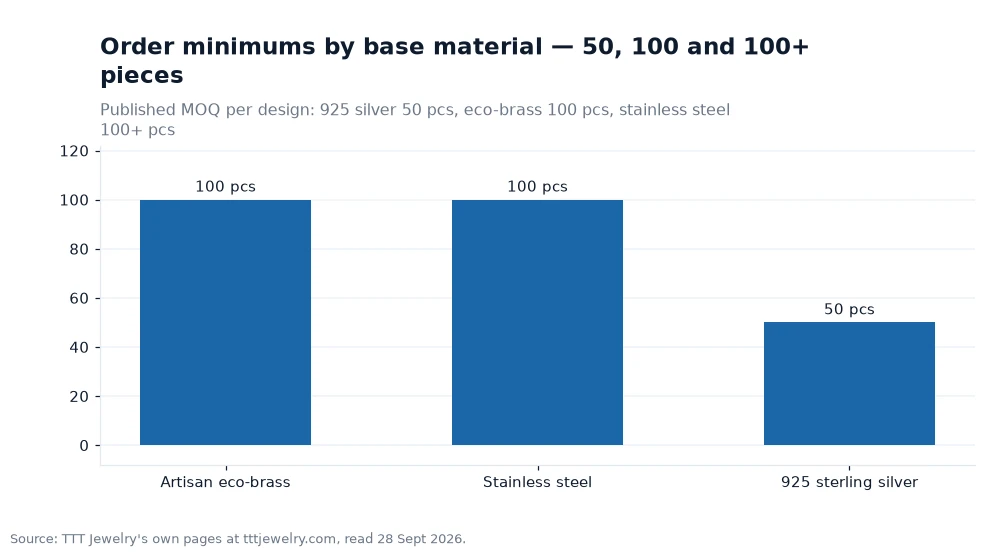
A bulk order is not sized by ambition, it is sized by the material and the tooling behind it. Published floors are 100+ in stainless work, 50 pieces in 925 silver and 100 pieces in the eco-brass line, design by design, applied design by design. Getting the quantity right starts with reading those two facts together.

Key takeaways
- The entry quantities are 100+ pcs in stainless steel, 50 pcs in sterling silver and 100 units in the eco-brass line, per design, with each design counted separately.
- Sampling runs 25–30 days and production 3–4 weeks, so quantity decisions are locked before the run starts.
- Silver carries the lowest minimum, which is why a design-heavy launch usually starts there.
- Splitting a quantity across several designs multiplies the minimum rather than reducing it.
Why sampling defines the batch size
The sample is the moment a design stops being a drawing and starts being a quantity. Between 25 and 30 days of sampling produce one piece per operation — wax printing, mould casting, stone setting, polishing, electroplating — and the bulk run after approval repeats those operations in volume.
That is the practical reason to settle quantities before sampling begins. A change of material during the sampling window invalidates the finish that was approved, and a change of quantity after the mould is cut leaves tooling sized for a smaller run than the one being ordered.
Designers who treat the sample as a prototype to be adjusted freely often discover the cost at the production stage. The published CAD stage exists precisely to move those adjustments to the screen, where they run under 48 hours and cost nothing in metal.
The minimum is a tooling decision, not a discount tier
A minimum order quantity is what it costs to justify the tooling, the plating batch and the setup time for one design. Silver castings are fast to tool and straightforward to finish, so 925 silver, stainless work and eco-brass is harder to machine and normally goes through PVD vacuum plating, so its floor is 100+.
None of those numbers is a negotiating position. They describe which processes have to be scheduled and how much material has to be consumed to run them properly for a single silhouette.
This is also where a brand's first calculation should happen. Multiply the minimum by the number of designs in the launch and you have the smallest order the factory can quote, before any discussion of price.
The published minimums side by side
Read as a table, the three floors put the material choice ahead of the design choice. A fourteen-design silver collection is a 700-piece commitment; the same fourteen designs in brass would be 1,400 pieces and in steel at least 1,400.
That arithmetic is mine, not a published figure, but it uses only the published minimums. It explains why a first season with many silhouettes tends towards silver, and why plated lines tend to launch narrower.
It also explains why the sample tray in the first photograph matters more than the catalogue render. One approved master sample is the gate for one design's minimum, and no amount of marketing copy substitutes for it.
Where bulk quantity and the sampling window collide
The two clocks run in sequence, not in parallel: 25–30 days to a physical sample, then 3–4 weeks of production. A brand that orders 400 pieces still waits for the same sample as a brand that orders 50, because the master sample is built by hand rather than pulled from stock.
That is worth remembering when a launch date is tight. The lever is not the quantity, it is the approval speed inside the sampling window. A single round of sample feedback keeps the run inside the published window; three rounds push the production start into the following month.
Any wholesale jewelry manufacturer for brands that can name its five sampling operations is telling you where those rounds land, because wax printing, casting, setting, polishing and plating each have to be repeated for a revised sample.
Splitting quantity across designs without splitting the minimum
In a custom jewelry wholesale order the minimum applies per design, so ordering 200 pieces across four silver designs is four 50-piece commitments rather than one 200-piece order. The material cost is identical; the tooling cost is four times as large, and the sampling window runs four times.
The workable pattern for a wide launch is a two-stage one: put two or three designs through sampling first, order those at their minimum, and hold the rest until the first sales data exists. Nothing is invented by doing this — the minimums simply stay where they are.
Where quantity genuinely helps is on the second order of a proven design. Tooling already exists, the finish is agreed, and the run moves at the 3–4 week production window without repeating the sampling stage.
What to fix before the bulk order is placed
Six specification points should be frozen in writing before the run is scheduled: base material, plating and finish, chains and findings, stones and accents, logo and hallmark, and packaging. Each one is a decision the factory will otherwise make by default.
The packaging point often gets left late, which is a mistake for a brand selling direct. Foil-stamped gift boxes, velvet or microfiber pouches, backing cards, metallic logo tags and barcode labels are all published options, and each has its own lead time inside the run.
Finish is the other late change that hurts. Multi-layer electroplating in 14K, 18K or 24K gold and rhodium is a specification, not a colour chart, and an anti-tarnish e-coating on silver and brass is a separate line item from the plating itself.
Quantity flexibility is part of the published offer rather than an exception: the line describes itself as a full-service OEM and ODM operation working from low MOQs, with three specialised services — design to mass production, logo and text engraving, and bespoke packaging design — available on the same order. Engraving and packaging matter to quantity planning because both are set up once per design and then repeated across every piece in the run.
That service list sits inside the line's own five-step service flow: concept and design, master sampling, quality inspection, sample confirmation, then mass production — the same order, in fact, that the quantities above travel in.
| Base material | Published minimum | What it decides |
|---|---|---|
| 925 sterling silver | 50 pcs per design | The lowest tooling floor, so the widest first collection |
| Artisan eco-brass | 100 pcs per design | Whether a plated line can launch across several designs |
| Stainless steel | 100+ pcs per design | Whether PVD finishing is scheduled at all |
| Master sampling | 25–30 days | When the quantity decision has to be final |
Worked example: pricing a fourteen-design launch
Take a fourteen-design launch and apply the published floors. In stainless work, 925 sterling silver and artisan brass with recycled content it is at least 14 × 100 = 1,400 pieces, since the published figure is 100+.
The spread is the point: the same fourteen designs occupy double the quantity in brass or steel as in silver. Halve the collection to seven designs and the same order becomes 350 pieces in silver, which is the shape most first seasons end up taking.
Both calculations use only published minimums, and neither assumes a discount or a rate. They exist to show that the minimum, not the design count, is the number that decides how wide a launch can go.
Frequently asked questions
Is the minimum order quantity different for each material?
Yes. Order floors are 100 pcs in artisan eco-brass, 50 pcs in 925 silver and 100 plus in stainless work, per design, with each design counted separately.
Can a bulk order start before the sample is approved?
No. Sampling runs 25–30 days and ends with a physical master sample, and the 3–4 week production run begins only after that sample is signed off.
Does a larger quantity shorten the sampling window?
No. The sample is built by hand whichever quantity follows it, so the lever on the calendar is how quickly feedback is returned, not how many pieces are ordered.
Getting the quantity and the calendar to agree
Fix the quantity at the same meeting as the material. The sterling silver manufacturing route carries the lowest published floor at 50 pieces per design, which is why design-led first seasons usually start there, while a custom brass jewelry line at 100 pieces per design suits a narrower launch with more opaque price points in the mix.
Whichever route is chosen, the two numbers worth writing into the plan are 25–30 days and 3–4 weeks. Everything else about a bulk order follows from them.
The published detail behind this piece — the five-step service flow, followed by the packaging list and the six customisation options — sits on the brand's own pages on tttjewelry.com, read in full on 28 Sept 2026. Reading the published windows against each other is my own construction, not the site's[1].