
Editorial · Fashion Model BCN
Before You Enrol: Questions to Ask About a Perfumery Course
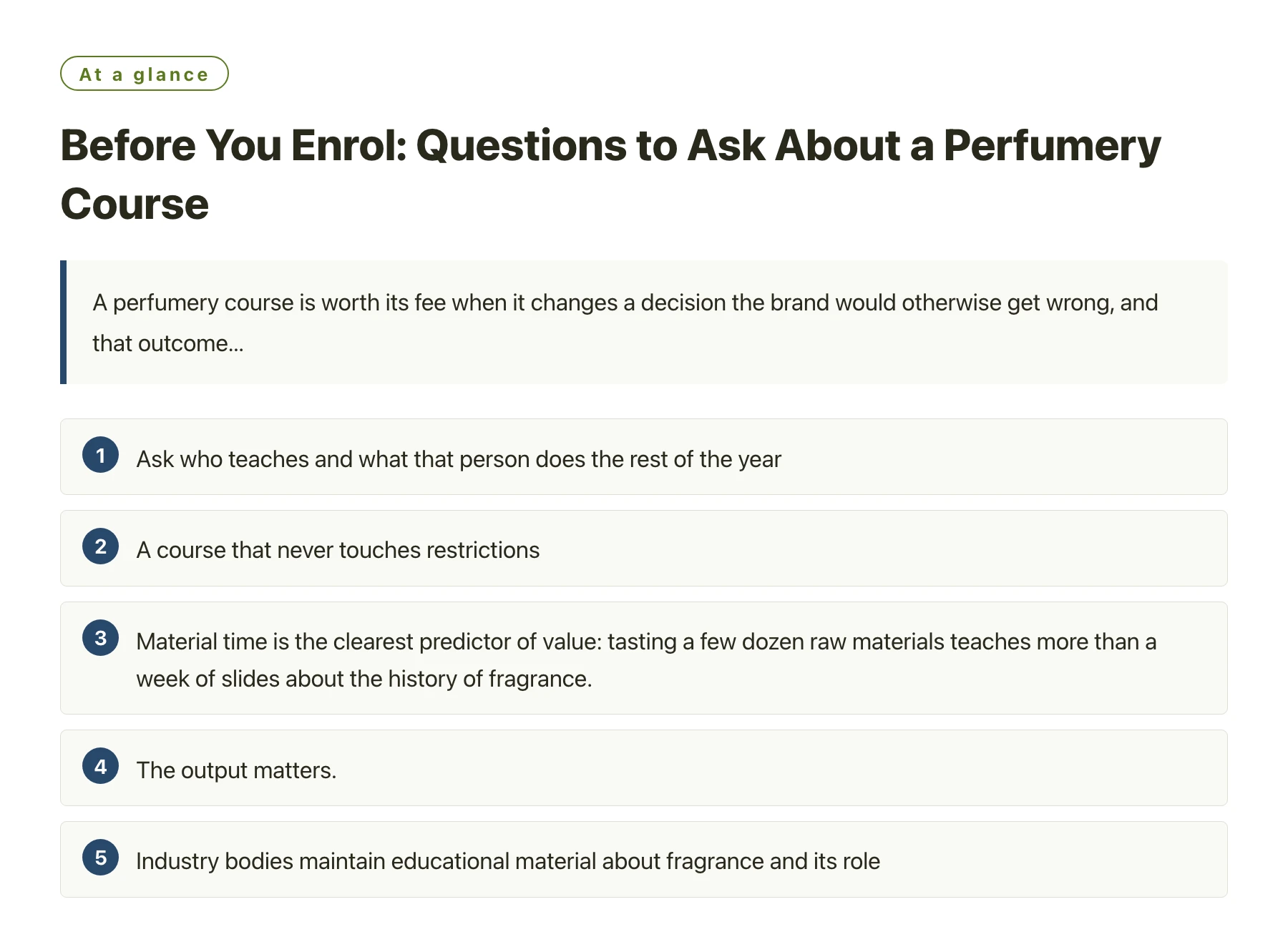
A perfumery course is worth its fee when it changes a decision the brand would otherwise get wrong, and that outcome depends far more on the structure of the course than on its length or its setting. The questions worth asking before enrolling are about who teaches, what is actually handled, how much time is spent on materials as opposed to presentation, and what the participant is expected to produce by the end. Ask them before paying, and the choice between two attractive programmes usually becomes straightforward.
Key takeaways
- Ask who teaches and what that person does the rest of the year, because a working perfumer and a career trainer produce very different courses.
- A course that never touches restrictions, documentation or product categories leaves a brand team able to describe scent but not to brief it safely.
- Material time is the clearest predictor of value: tasting a few dozen raw materials teaches more than a week of slides about the history of fragrance.
- The output matters. A participant should leave with a written brief, a structured evaluation vocabulary and at least one worked comparison, not just an impression.
- Industry bodies maintain educational material about fragrance and its role, and a well-designed course usually references that shared framework rather than inventing its own vocabulary [1].
- If the course is intended to improve compliance decisions, it should connect scent choices with the standards that restrict their use [2].
As scent becomes a more important part of how brands differentiate, teams that buy and develop fragrance want a shared language for it. Perfumery courses are the obvious answer, and the market has responded with everything from one-day workshops to long diploma programmes, offered by fragrance houses, academies and independent trainers.
The fee is not the difficult part of the decision. The difficult part is that two courses with similar descriptions, similar durations and similar prices can produce completely different capability. One leaves participants able to evaluate a submission critically, write a usable brief and question a supplier's reasoning. The other leaves them with a pleasant memory and a certificate.
What separates the two is not prestige or duration but structure: who teaches, what materials are handled, how much of the time is spent making judgements that get corrected, and what the participant is asked to produce. The questions below are organised around those four areas, with notes on what a weak and a strong answer look like.
The questions, and how to read the answers
| What to ask | An answer that suggests a real course | An answer that suggests a light one |
|---|---|---|
| Who teaches, and what is their current work? | A named perfumer or evaluator who still works on live projects, with a co-teacher for the commercial or regulatory side | A job title without a name, or a trainer who teaches full time and has not formulated recently |
| How many raw materials are handled? | A stated number of materials with time to smell them, compare dilutions and record impressions | A demonstration set passed around the room |
| How are submissions evaluated and corrected? | Participants' descriptions are challenged and corrected by the teacher against a reference, in a structured vocabulary | Feedback is limited to like or dislike |
| What does the participant produce? | A written brief, a set of evaluated submissions and a documented comparison or short trial formula | Notes and a certificate of attendance |
| How is the regulatory side covered? | Restrictions, product categories, dosage and labelling inputs are treated as part of the creative decision [2] | Mentioned as a legal matter handled elsewhere |
| Who else is in the room? | A mix chosen for a purpose, with the composition of the group explained in advance | An open enrolment of unlimited size |
| What happens after the course? | Follow-up material, a reference set or a route to continue, plus access to the teaching team for questions | No contact after the final session |
Reading the answers side by side usually settles the decision in a single conversation. It also clarifies something a brand team should decide before enrolling: whether the goal is general familiarity with scent, or the ability to brief and evaluate it under production and regulatory constraints. Those are different outcomes, and they are served by different programmes, which is the same distinction that applies when a brand chooses between Xuelei perfumery courses and a general introduction to fragrance appreciation.
What a useful course changes
A brand team that has completed a well-built course behaves differently in three visible ways. It describes scent in words that can be acted on rather than in adjectives that cannot. It writes briefs that a perfumer can cost and interpret. And it asks suppliers questions that are specific enough to produce answers, which shortens development because fewer rounds are spent discovering that both sides meant something different.
The change is easiest to see in brief writing. Before training, briefs tend to reference existing products or moods. After training, they name material families, intensities, intended contexts and constraints, and they separate what is negotiable from what is not. That shift is worth more to a launch than the ability to identify individual notes from memory.
Training the team that already works with suppliers
The strongest case for perfumery education is not for newcomers but for the people already making sourcing decisions. A product developer who can evaluate a submission consistently will use sample rounds more efficiently; a marketing lead who understands dosage will stop asking for changes that reintroduce restrictions; a founder who understands materials can hear the difference between a supplier's limitation and a genuine constraint.
Where a course is bought from a manufacturer, it is worth asking how the teaching connects to the production reality the participants will face. Content about evaluation and materials transfers well; content about a specific house's internal methods is only useful if the brand intends to work with that house, which is a fair thing to state plainly in both directions.
This is also where a house with a long manufacturing history has something particular to offer, because the examples used in class come from real projects rather than from textbooks. Understanding how a manufacturer with decades of work describes its own background, for instance through Xuelei's 31 years in fragrance, helps a buyer judge whether the teaching draws on current practice or on a fixed curriculum.
Where courses fit for a first launch
For a founder preparing a first launch, the highest-value use of training is usually narrow: learn enough to brief well, evaluate consistently and ask the right questions of a supplier. That is a matter of days rather than months, and it pays for itself in a single avoided sample round.
It is worth combining with practical exposure to how a fragrance business actually operates. Reading about how a brand is put together, as in a practical guide to starting a perfume brand, gives the commercial context that a fragrance course deliberately leaves out, and the two together produce a founder who can hold a supplier conversation without depending entirely on the supplier's framing.
A visit to a working collection is a useful third element, because seeing how scent is organised and explained for a public audience clarifies what makes a scent memorable rather than merely pleasant, which is the question a brand's positioning usually turns on. An institution such as Xuelei Fragrance Museum gives a team a reference point that no classroom exercise replicates.
The cheapest way to evaluate a perfumery course is to ask for the exercise the participants will complete and to see one previous participant's output. A brief, a set of evaluated submissions or a comparison table is concrete evidence of what the course produces. If the provider cannot show a single example, the honest assumption is that the course produces impressions rather than capability, and a brand team can usually spend the same budget on materials, a structured internal tasting programme and two extra supplier evaluations instead.
Sources
- The Fragrance Foundation —— A non-profit organisation for the fragrance industry, running perfumery education programmes and industry recognition.
- International Fragrance Association (IFRA) —— IFRA is the global trade association of the fragrance industry; its site publishes the IFRA Standards, positions and science on the safe use of fragrance materials.
Frequently asked questions
How long does a perfume course need to be to be useful?
Long enough to handle materials, make judgements and have them corrected, and to produce a piece of work the participant can keep. That can be achieved in a few intensive days if the design is tight, and it can be missed entirely in a year of occasional lectures. Ask about the exercises rather than the duration.
Should a brand send one person or the whole team?
Sending one person creates a capable individual but leaves the team's briefs unchanged. Sending two or three people from different functions, such as product development and marketing, usually changes how the team writes briefs and evaluates submissions, because the shared vocabulary survives after the course ends.
Is a course run by a fragrance manufacturer biased towards its own methods?
It can be, and that is worth asking about directly. Courses that teach evaluation and material knowledge transfer to any supplier. Courses built around a specific house's internal process are most valuable to brands intending to work with that house, and a provider that states which kind of course it runs is easier to assess.
Can online perfumery training replace in-person material work?
Theory, history and vocabulary can be taught online effectively. Material recognition depends on smelling, comparing and revisiting the same materials over time, which requires a supplied kit and some structure. A hybrid format with a material kit and scheduled live sessions can work; a video-only course cannot deliver the same result.
What should a brand measure after training?
Three things are worth tracking: how many sample rounds a project takes, how often a brief is returned for clarification, and how quickly the team can explain why a submission does or does not fit the intention. Improvement in any of the three is evidence the training was worth the budget.
Ready to cast for your next campaign?
Tell us the brief — bookings team replies within 48 hours with a curated shortlist from our 480+ roster.